Author: Pine Analytics
Compiled by: Odaily Planet Daily, Ethan
Original Title: L1 Value Capture Shrinks Significantly, ETH, SOL, HYPE Struggle to Return to Price Peaks
Editor's Note: Over the past few years, the crypto market once believed that the fee revenue of L1 public chains was the core cash flow supporting token valuations. However, this research uses on-chain data to reveal a different reality: whether it's Bitcoin's congestion cycles, Ethereum's DeFi and NFT peaks, or Solana's memecoin frenzy, all fee booms are ultimately compressed by innovation. Demand explosions lead to revenue peaks, peaks stimulate the emergence of alternatives, and profits are systematically squeezed out. The compression of L1 value capture is not a cyclical phenomenon but a structural outcome of open networks.
By 2026, the market has long ceased to price L1s solely based on 'fee capture.' The price drivers for ETH and SOL are shifting from L1 fee logic to staking yields, ETF fund flows, RWA narratives, protocol upgrade expectations, and macro liquidity conditions. The compression trend continues, but the pricing anchors have migrated. What's truly worth pondering is not just whether fees will continue to decline, but also: when the market prices L1s not based on 'on-chain profits' but on 'asset narratives' and 'structural fund flows,' whether this new logic is equally fragile; and when narratives recede, what fundamental support will prices return to.

L1 blockchains struggle to earn fees sustainably and stably during their scaling phases. Every major revenue source they once found—from transaction fees to MEV—is eventually eroded bit by bit through various arbitrage methods by the users they serve. This isn't a failure of any particular chain; it's an inherent characteristic of open, permissionless networks: whenever an L1 earns enough from fees to reach a certain scale, transaction participants devise new ways to compress that revenue to near zero or directly eliminate it.
Bitcoin, Ethereum, and Solana are among the most successful networks in crypto. Interestingly, although they process billions of dollars in value flow daily, all three have followed nearly the same path: fee revenue spikes dramatically in the short term, capturing everyone's attention, only to be soon snatched away or have their income分流 by L2s (Layer 2 networks), private order flow, MEV-aware routing tools, or new application-layer innovations. This pattern has recurred in every fee model, every MEV wave, and every scaling solution in the crypto industry, with no signs of slowing down.
This article argues that L1 fee compression is a long-standing and accelerating phenomenon. It will梳理 the specific innovative practices that compress profits at different stages and explore what this means for L1 tokens whose valuations still incorporate assumptions of 'sustainable fee earnings.'
Bitcoin
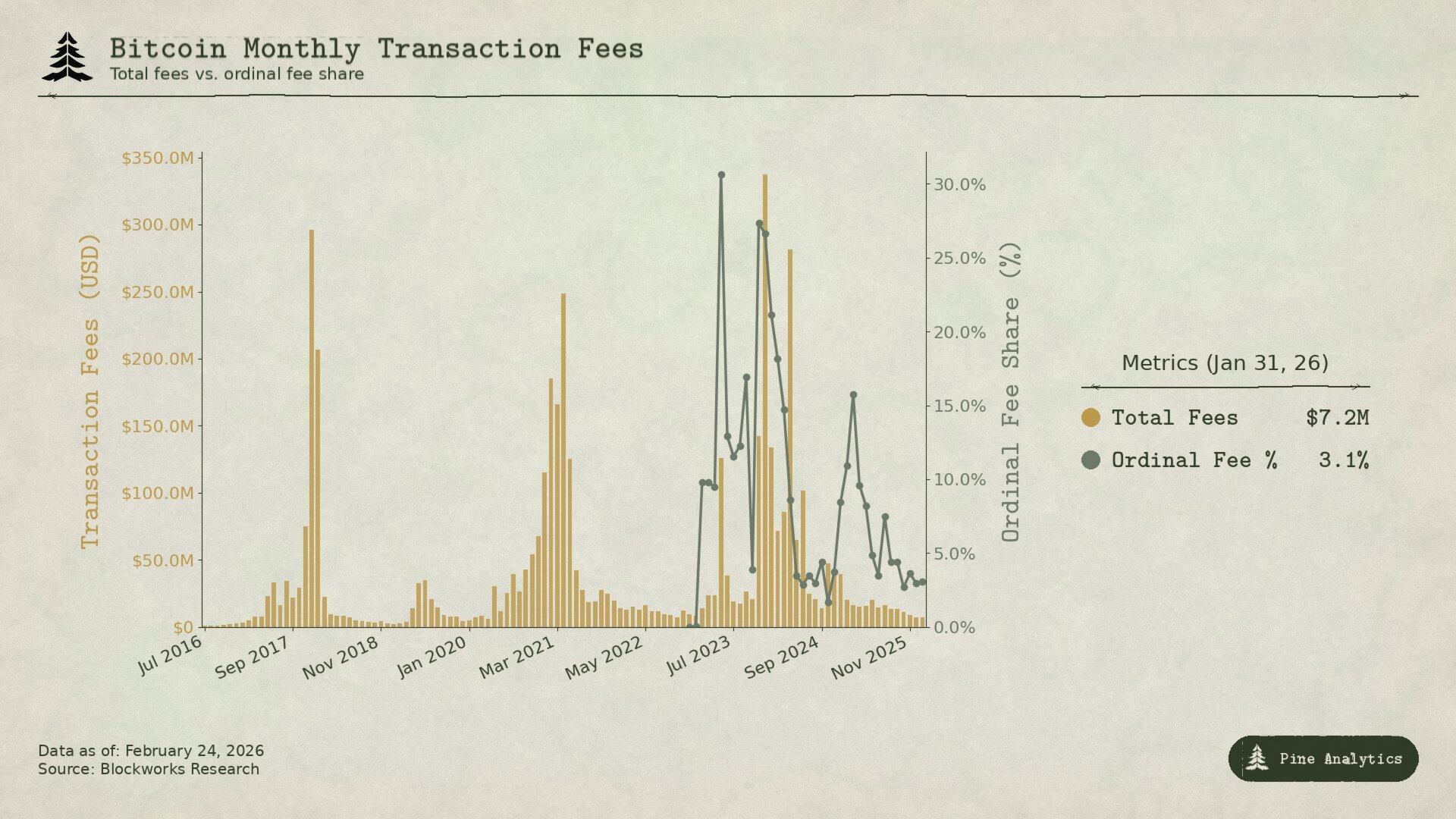
Bitcoin's fees are almost entirely earned from congestion during on-chain BTC transfers—when everyone rushes to transact, fees naturally rise. Moreover, since Bitcoin lacks smart contracts, there's virtually no MEV in its network. The key issue is: each time a BTC price increase drives a fee surge, the magnitude of the fee increase relative to the scale of economic activity at the time has been weaker than in the previous cycle.
In 2017, BTC rose from $4,000 to $20,000. The average fee also surged from less than $0.40 to over $50. At the peak on December 22nd, fees constituted 78% of miner block rewards: fees alone amounted to approximately 7,268 BTC, nearly four times the block subsidy. But within just three months, fees plummeted by 97%, returning to their original state.
The market reacted very quickly, soon developing countermeasures. In early 2018, SegWit transactions accounted for only 9%; by mid-year, they had risen to 36%. Although such transactions made up over one-third of the total transaction volume, they contributed only 16% of the fees. Exchanges also began adopting batching, combining hundreds of withdrawals into a single transaction, saving significant fees. These factors combined led to a 98% reduction in fees within six months. Additionally, the Lightning Network officially launched in early 2018, specifically addressing the fee issue for small transactions; Wrapped BTC on other chains also allowed users to gain BTC exposure without necessarily operating on the Bitcoin mainnet.
By the time BTC reached its price peak in 2021 at $64,000, the monthly fee revenue was actually lower than in 2017. There were fewer on-chain transactions then, but the dollar-denominated transfer volume was 2.6 times higher than in 2017—simply put, the network transferred more value, but the fees captured didn't keep up and even decreased.
The current cycle illustrates this unstoppable trend even more clearly. BTC rose from $25,000 to over $100,000, an increase of roughly 3 times (the原文 mentioned 4 times, adjusted slightly based on the actual price range without changing the meaning), but standard transfer fees never surged as dramatically as in previous cycles. By the end of 2025, daily transaction fees were only about $300,000, less than 1% of miners' total income. Bitcoin's total fees for 2024 were $922 million, but most came from the short-term hype of Ordinals and Runes, not stable income from traditional BTC transfers. By mid-2025, spot Bitcoin ETFs held over 1.29 million BTC, approximately 6% of the total supply, providing large-scale BTC exposure demand for the market without generating any on-chain fees. The on-chain interaction required to acquire Bitcoin assets has been largely engineered away.
Ordinals and Runes once pushed the fee share of miner income to 50% in April 2024, but as related tools matured, by mid-2025, this ratio had fallen back below 1%. These short-term spikes resemble more of a偶然收益 from MEV rather than stable income from congestion, stemming more from immature tooling around new asset types than from genuine demand for BTC settlement.
The pattern is quite clear: whenever Bitcoin earns enough from fees to be noticeable, cheaper alternatives emerge within the ecosystem. The L1 can only capture a short-term fee peak from each type of demand once, after which that profit is gradually eaten away by continuous innovation.
Ethereum
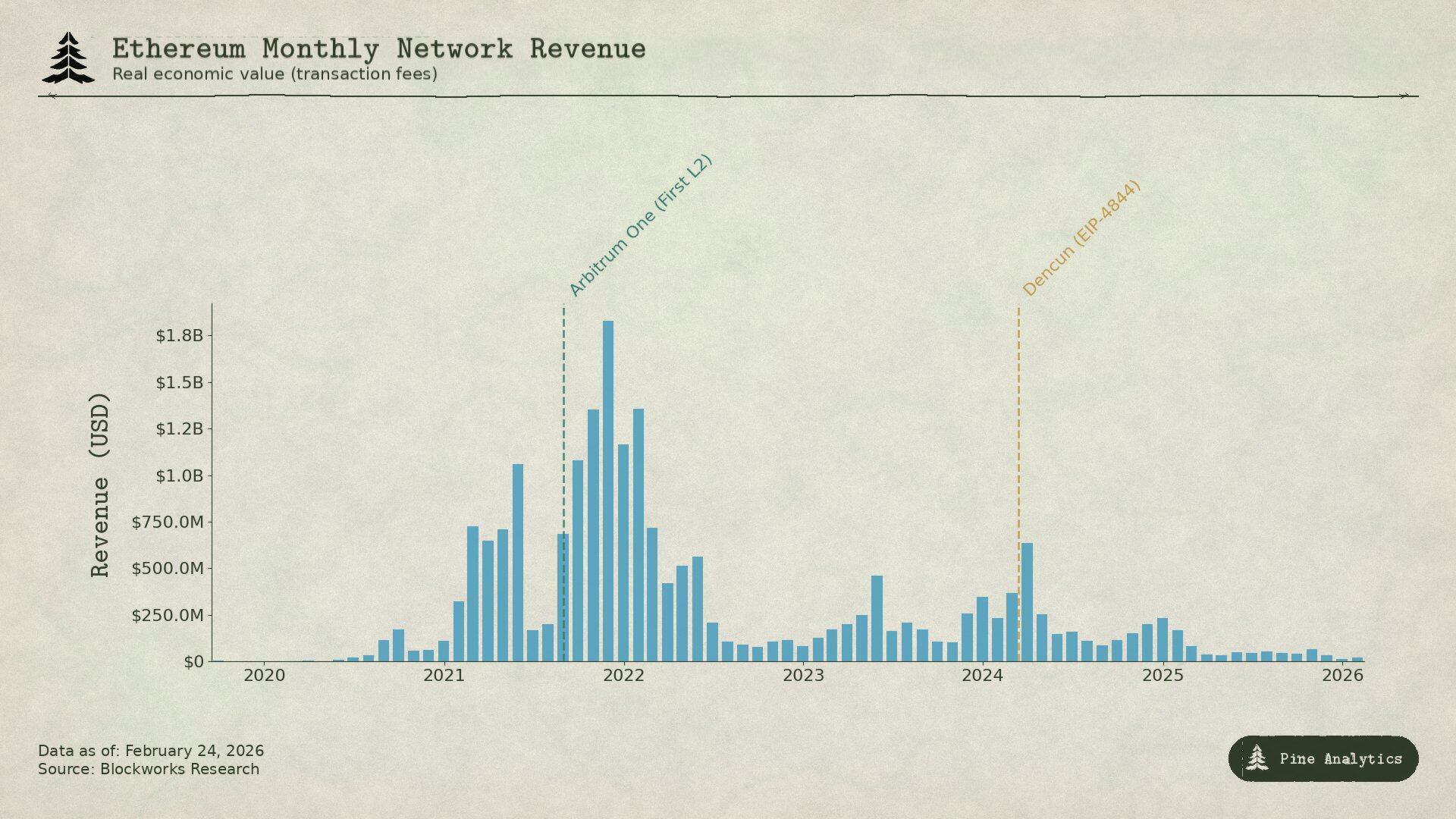
Ethereum's fee story is even more dramatic. Because this chain genuinely captured enormous value, only to watch it be systematically dismantled.
In mid-2020, "DeFi Summer" made Ethereum the center of a new financial system. Uniswap's monthly trading volume skyrocketed from $169 million in April to $15 billion in September. TVL grew from less than $1 billion to $15 billion by year-end. In September 2020, Ethereum miner fee income set a record of $166 million, six times that of Bitcoin miners. This was the first time a smart contract platform earned substantial, sustained income from real economic activity.
In 2021, NFTs叠加 on top of DeFi. The average transaction fee reached $53 during peaks. Quarterly fee income grew from $231 million in Q4 2020 to $4.3 billion in Q4 2021, an increase of 1,777%. The implementation of EIP-1559 in August 2021 introduced a base fee burn mechanism, permanently removing a portion of fees from the market. At that time, it seemed Ethereum had solved the core problem of L1s not being profitable.
But in reality, these fees were essentially "congestion fees": users paid $20 to $50 not because the transaction was worth that much, but because everyone was cramming onto the chain, exceeding Ethereum's processing capacity of about 15 transactions per second (15 TPS). This inherent shortcoming left ample room for cheaper alternatives.
Other L1s like Solana, Avalanche, and BNB Chain offered transactions for just a few cents; Ethereum's L2 Rollups, like Arbitrum and Optimism, snatched even more business—they process transactions on their own networks and then send compressed transaction batches back to the Ethereum mainnet for settlement, making them fast and cheap.
Subsequently, Ethereum performed a "self-weakening." The Dencun upgrade on March 13, 2024, introduced Blob transactions (EIP-4844), providing L2s with a cheaper data publication path. Before this, L2s used calldata, costing about $1,000 per megabyte. After the upgrade, Arbitrum's single transaction fee dropped from $0.37 to $0.012; Optimism from $0.32 to $0.009. The median Blob fee dropped to almost zero. Ethereum intended to retain users with this move, but instead ended up削弱ing its last significant source of fee income.
Looking at the data makes it even more直观. In 2024, L2s generated $277 million in revenue but paid only $113 million to Ethereum. By 2025, L2 revenue fell to $129 million, while the amount flowing back to Ethereum was only about $10 million, less than 10% of L2 revenue, a year-on-year decrease of over 90%. The once monthly average L1 fee income of over $100 million had fallen below $15 million by Q4 2025. The chain that created $4.3 billion in revenue in a single quarter saw its income scale shrink by about 95% just four years later.
Bitcoin's income was compressed because people could obtain BTC without using the chain; Ethereum's income was compressed in two waves: the first was other alternative networks吸走ing users unwilling to pay high congestion fees; the second was Ethereum's own scaling plan, pushing the cost of L2 data transmission to almost zero, making it unable to earn from settlement anymore. In both cases, the L1 either built or allowed the tools that snatched its own income to emerge.
Solana
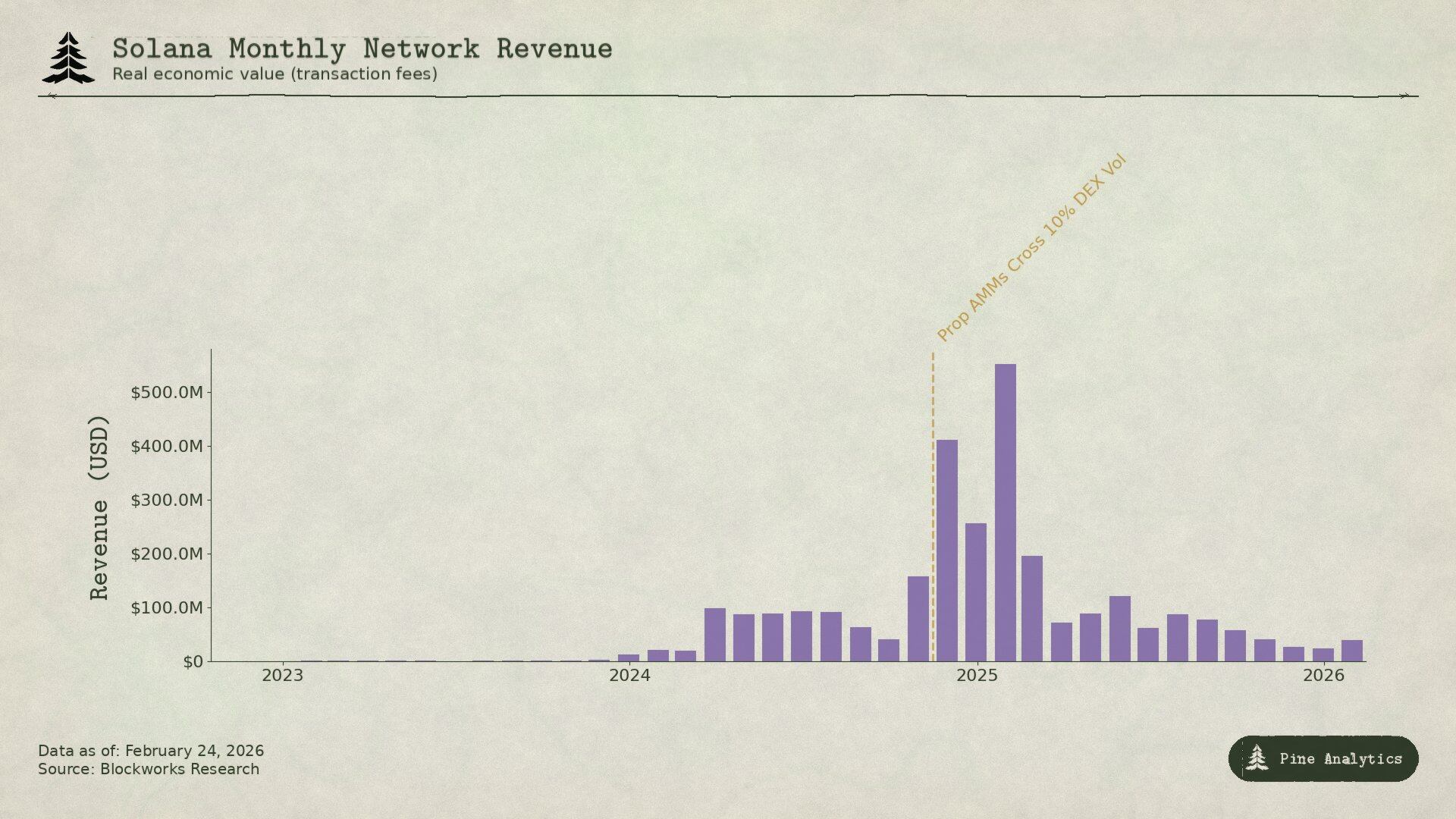
Solana's revenue logic is completely different from Bitcoin and Ethereum—it hardly relies on congestion for fees. The base fee is fixed at 0.000005 SOL per signature, cheap enough to be almost negligible. Approximately 95% of fee income comes from priority fees and MEV tips paid through the Jito block engine. In Q1 2025, Solana's "Real Economic Value" (REV) reached $816 million, with 55% coming from MEV tips. In 2024, validators earned roughly $1.2 billion, while operating costs were only about $70 million, leaving a significant profit margin.
The key to Solana's fee explosion was memecoin trading. Pump.fun, launched in January 2024, earned over $600 million in protocol revenue in less than 18 months, contributing up to 99% of memecoin issuance at its peak. DEX daily trading volume once reached $38 billion. In January 2025, the launch of the TRUMP token drove single-day priority fees to 122,000 SOL and MEV tips to 98,120 SOL. In 2024, the top 1% of memecoin traders contributed $1.358 billion in fees, nearly 80% of total memecoin fees. Almost entirely driven by MEV.
Today, two types of innovation are compressing this income.
The first is proprietary AMMs. Protocols like HumidiFi, SolFi, Tessera, ZeroFi, and GoonFi use private vaults managed by professional market makers, providing internal quotes and updating prices multiple times per second. Since liquidity is not publicly available, MEV bots cannot perform sandwich attacks. More critically, proprietary AMMs route orders through aggregators like Jupiter, actively choosing counterparties rather than passively exposing themselves to anyone willing to pay MEV tips as public pools do. By keeping pricing private and continuously refreshing, they eliminate the "stale quote" problem—the source of a significant portion of Solana's MEV revenue. HumidiFi processed nearly $100 billion in trading volume in its first five months after launch. Today, proprietary AMMs account for over 50% of Solana DEX trading volume, with even higher shares in highly liquid pairs like SOL/USDC.
The second is Hyperliquid migrating the most profitable spot trading activity directly off Solana. Using its self-developed HyperCore technology, it built a set of native bridging tools that allow tokens on Solana to be deposited onto Hyperliquid, withdrawn back, and traded on its spot order book. When Pump.fun launched the PUMP token in July 2025, pricing occurred on Hyperliquid, not Solana's DEXs, via the HyperCore cross-chain bridge. Before this, Hyperliquid had already tested this model with SOL itself and tokens like FARTCOIN—the phase when prices are first established, with the largest spreads, most volatility, and easiest MEV profits, has gradually been moving off Solana.
These two approaches compress Solana's income from two directions: proprietary AMMs reduce the MEV transactions remaining on Solana, while Hyperliquid directly migrates the spot trading most capable of generating MEV profits off-chain. By Q2 2025, Solana's REV had decreased by 54% compared to the previous quarter, to just $272 million; daily MEV tips had fallen over 90% from the January peak, to less than 10,000 SOL per day.
The pattern is actually the same as the previous two chains, just with a different revenue method: Solana's fees are essentially short-term earnings from MEV during the initial, chaotic phase of new trading玩法. Once proprietary AMMs optimize trading efficiency and Hyperliquid吸走s high-value orders, these profits quickly shrink. The L1 can earn a large sum during market frenzies, but the market always quickly devises new methods to prevent such short-term gains from lasting.
Impact on Token Prices
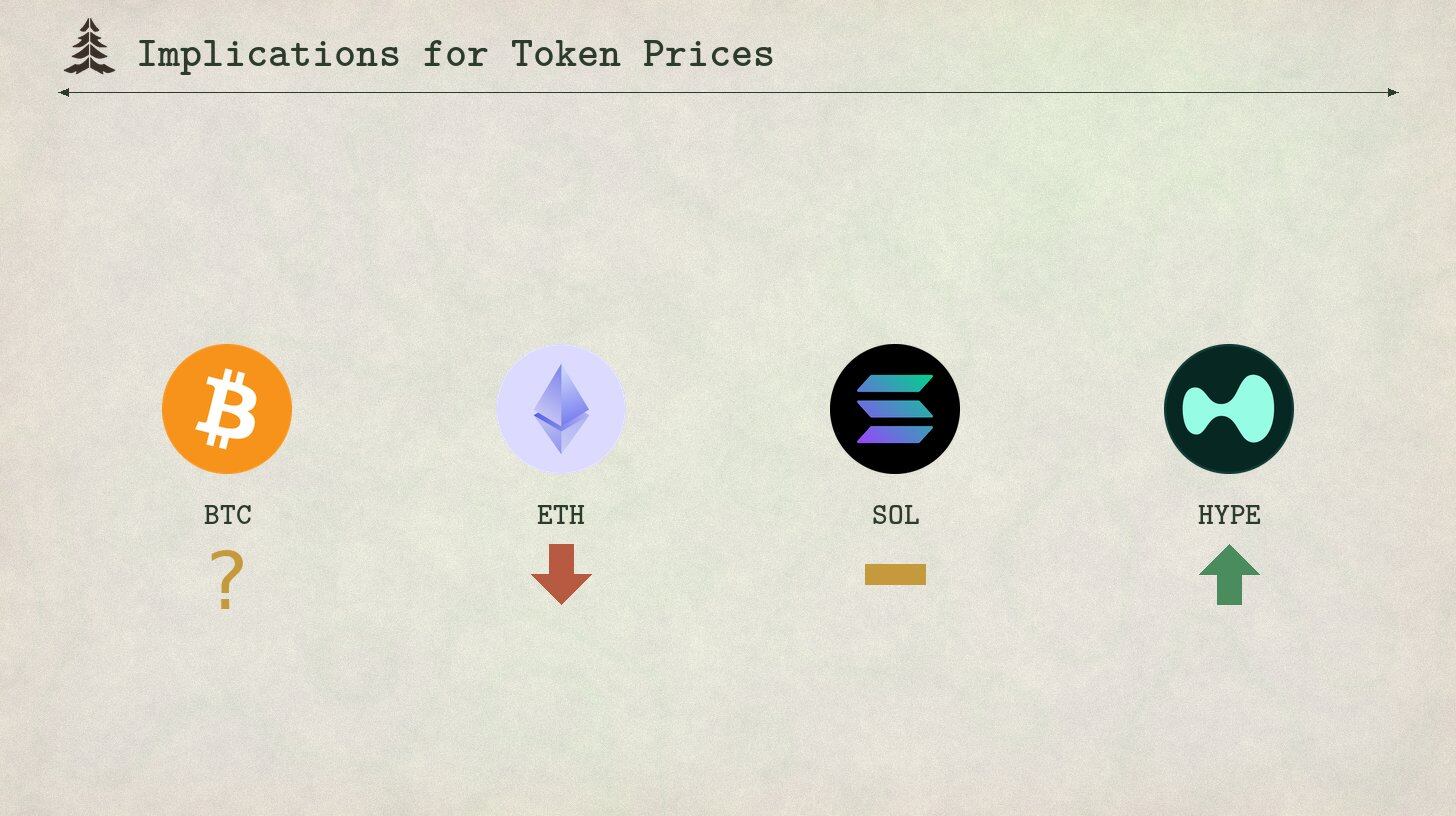
The pattern demonstrated by the three chains above is not merely a post-hoc description; it is also somewhat predictive. Every L1 fee mechanism follows the same trajectory: new demand brings an income peak, the peak attracts innovation, innovation compresses profits, and this compression, once it occurs, is difficult to reverse. Following this logic, we can make a general judgment about the future of four tokens.
Ethereum: Persistent Fee 'Collapse'
Ethereum's fees have not yet found a clear bottom. In 2024, L2s paid $113 million to the Ethereum mainnet; by 2025, this plummeted to approximately $10 million, a drop of over 90%. Each new L2 further reduces demand for Ethereum mainnet block space, and Ethereum's own scaling plans continue to lower data transmission costs. EIP-4844 was not a one-time repricing but the starting point of a structural shift—Ethereum actively subsidizes infrastructure tools that route activity outside its fee market. Currently, monthly L1 fee income has fallen below $15 million, and the forces driving the decline are still strengthening. If Ethereum cannot create entirely new sources of L1-native demand, the token price will continue to reflect this compression trend. ETH is increasingly resembling a low-yield infrastructure asset rather than the high-growth smart contract platform it once was.
Solana: Record High Activity, Not Necessarily Price
Solana will almost certainly achieve new highs in on-chain activity in the next cycle—its ecosystem is deep enough, developers numerous enough, and infrastructure mature enough—but fee revenue may not follow suit. The memecoin frenzy from late 2024 to early 2025 was, for Solana, equivalent to Bitcoin's "SegWit moment": a fee peak supported by new demand, quickly compressed by innovation thereafter.
Currently, proprietary AMMs already handle over 50% of DEX trading volume, significantly削弱ing MEV. Hyperliquid's HyperCore technology is still moving the most profitable pricing环节 off-chain. Even if on-chain activity is 2 to 3 times higher than in January 2025, its fee system has matured to the point where it is difficult to convert this activity into corresponding validator income. Current average daily MEV tips are down over 90% from the peak, but on-chain activity remains healthy. Without sufficient fee income to support valuation, even if Solana's usage hits new highs, the possibility of SOL breaking its all-time high in the next cycle is not great.
Hyperliquid: The Before and After of Boom and Compression
Hyperliquid is the most noteworthy case because it represents the next stage of this "earn-get compressed" cycle, and the market has not yet realized how the latter half of this cycle will play out.
Hyperliquid is already a leading decentralized exchange for traditional financial asset perpetual contracts (perps). During recent silver volatility peaks, markets deployed under HIP-3 captured about 2% of global silver trading volume, with median spreads for retail-sized trades even better than COMEX. At times, traditional financial instruments accounted for about 30% of the platform's volume, with daily nominal trading exceeding $5 billion. Platform revenue in 2025 was approximately $600 million, with 97% used for HYPE buybacks and burns.
We expect Hyperliquid to continue dominating TradFi asset perps trading. Its product indeed has advantages: commodities and stocks can trade 24/7, even when traditional markets are closed; new markets can be added without approval via HIP-3 proposals; it offers up to 20x leverage on assets where CME requires 18% initial margin. In the next bull run, if trading volume and fees keep rising, the HYPE token might repriced similarly to Solana's rebound from bear market lows. If traditional financial asset trading volume continues to expand, HYPE will likely follow a similar path. Investors are likely to extrapolate future sustained high earnings based on one quarter's high revenue.
But Hyperliquid's fee model already sows the seeds of compression. The platform charges takers a fee of 4.5 basis points of the nominal value, with discounts of up to 40% based on trading volume and staking. This is fundamentally different from traditional financial derivatives pricing logic. On the CME, the exchange fee for one E-mini S&P 500 contract is about $1.33 per side, unrelated to the contract's nominal value of over $275,000,折算ing to less than 0.001 basis points. For a $10 million nominal position: CME fees are about $2.50, while Hyperliquid charges $4,500, a difference of about 1,800 times.
This spread exists because Hyperliquid's current user base is primarily retail and crypto-native. But TradFi perps products will bring TradFi expectations. As trading volume expands and institutional participants enter, pressure to converge towards a CME-style economic model will significantly increase. Hyperliquid's own fee structure already hints at the direction: the HIP-3 growth model slashes taker fees for new markets by over 90%, down to a minimum of 0.0045%; top traders even get below 0.0015%. The protocol is actively推进ing fee compression. Competitive perps DEXs, and future traditional trading venues offering on-chain products, will further accelerate this process. The end result无非 two outcomes: either Hyperliquid loses volume due to high fees, or it changes its fee structure to a fixed fee model similar to CME. Either way, the long-term high revenue currently anticipated by investors is difficult to achieve, and the HYPE token could experience a rapid price adjustment downward.
Bitcoin: Price Must Grow Before Fees
Among these four assets, Bitcoin is the most unique because the logical relationship between its fees and token price is reversed. For Ethereum, Solana, and Hyperliquid, the logic is: fees generate revenue, revenue supports valuation, fees get compressed, token price falls; but for Bitcoin, it's the opposite. Miners must rely on持续上涨的币价 to survive after each block reward halving—because fee income has proven unable to fill the gap left by the reduced block subsidy.
The 2024 halving reduced the block reward from 6.25 BTC to 3.125 BTC, daily issuance from 900 BTC to 450 BTC. By the end of 2025, average daily transaction fees were about $300,000, constituting less than 1% of miner total income. Although Bitcoin's total fee income for 2024 reached $922 million, most came from the阶段性高峰 of Ordinals and Runes, not sustainable natural fee demand. Current fee contribution is almost negligible; miner income relies almost entirely on the block subsidy, which halves every four years and is denominated in BTC. The only way miners can remain profitable through halving cycles is for Bitcoin's dollar price to roughly double within a similar timeframe, offsetting the 50% reduction in BTC-denominated income. Historically, this condition has held. But this foundation is extremely fragile. The chain's security budget is not funded by usage but by the持续上涨 of the asset price. If, during any halving, the price doesn't rise, mining becomes unprofitable, hash rate drops, network security suffers, potentially陷入ing a vicious cycle of "price drop → hash rate drop → security worsens → price drops further."
This also makes Bitcoin's "sustainability" more fragile than it appears. The ability of the price to support network security with almost no fees is a mechanism other chains find difficult to replicate, because Bitcoin is first and foremost a monetary asset, not a smart contract platform.
People buy BTC to hold it, not to use its block space. This gives Bitcoin an advantage the other three chains lack: demand for the货币 drives the price up, allowing network security to be maintained even with very low fees.
But this also means Bitcoin's long-term security relies entirely on one assumption—that the price keeps rising—and no one can guarantee that. Whether this chain can remain a secure settlement layer depends not on its ability to create fee-earning applications, but on its ability to maintain the narratives and market conditions that make people want to buy BTC. So far, this model is still functioning normally, but whether price increases can fill the gap as the block subsidy drops further from 3.125 BTC to 1.5625 BTC, 0.78125 BTC, over the next three to four halvings, will be one of the most critical unknowns in the crypto space.
Twitter:https://twitter.com/BitpushNewsCN
Bitpush TG Discussion Group:https://t.me/BitPushCommunity
Bitpush TG Subscription: https://t.me/bitpush